
In a historic facility in Philadelphia, a small team of specialized artists is tasked with a unique challenge: capturing the nation's history and identity on the smallest of canvases. These are the medallic artists of the United States Mint, the sculptors and designers who create the images found on every coin in circulation.
Their work transforms simple metal discs into pocket-sized pieces of public art, blending traditional craftsmanship with modern technology. This intricate process ensures that every quarter, dime, and nickel tells a story, connecting millions of Americans to their shared heritage every day.
Key Takeaways
- A dedicated team of medallic artists at the U.S. Mint in Philadelphia designs all American currency.
- The process involves translating complex historical and cultural themes into miniature, durable sculptures.
- Artists like Eric David Custer use both digital tools and traditional sculpting techniques to create coin designs.
- Upcoming projects include new designs for the nation's semiquincentennial celebration.
Inside the Philadelphia Mint's Art Department
The United States Mint production facility in Philadelphia is more than just a factory for currency; it is a hub of artistic creation. Within its walls, a select group of artists works to uphold a tradition that dates back to the nation's founding. These individuals are not just illustrators; they are engravers, sculptors, and historians rolled into one.
The role of a medallic artist is highly specialized. They must possess a deep understanding of relief sculpture, metallurgy, and the technical constraints of the coining process. A design that looks beautiful on a screen or in a clay model must also be able to withstand the immense pressure of the coining presses and endure decades of circulation.
A Legacy of Coined Art
The U.S. Mint in Philadelphia was the first federal building erected under the Constitution. Since its establishment in 1792, it has been the primary center for the nation's coin design and production, making its artistic department a cornerstone of American numismatic history.
The artists work in a collaborative environment, often competing for their designs to be chosen for new coins. The selection process is rigorous, involving reviews by committees like the Citizens Coinage Advisory Committee (CCAC) and the U.S. Commission of Fine Arts before a final recommendation is made to the Secretary of the Treasury.
From Digital Sketch to Physical Coin
The journey of a coin design begins long before any metal is struck. It starts as an idea, a theme meant to commemorate a person, place, or pivotal moment in American history. Artists research their subjects extensively to ensure historical accuracy and cultural sensitivity.
The Modern Toolkit
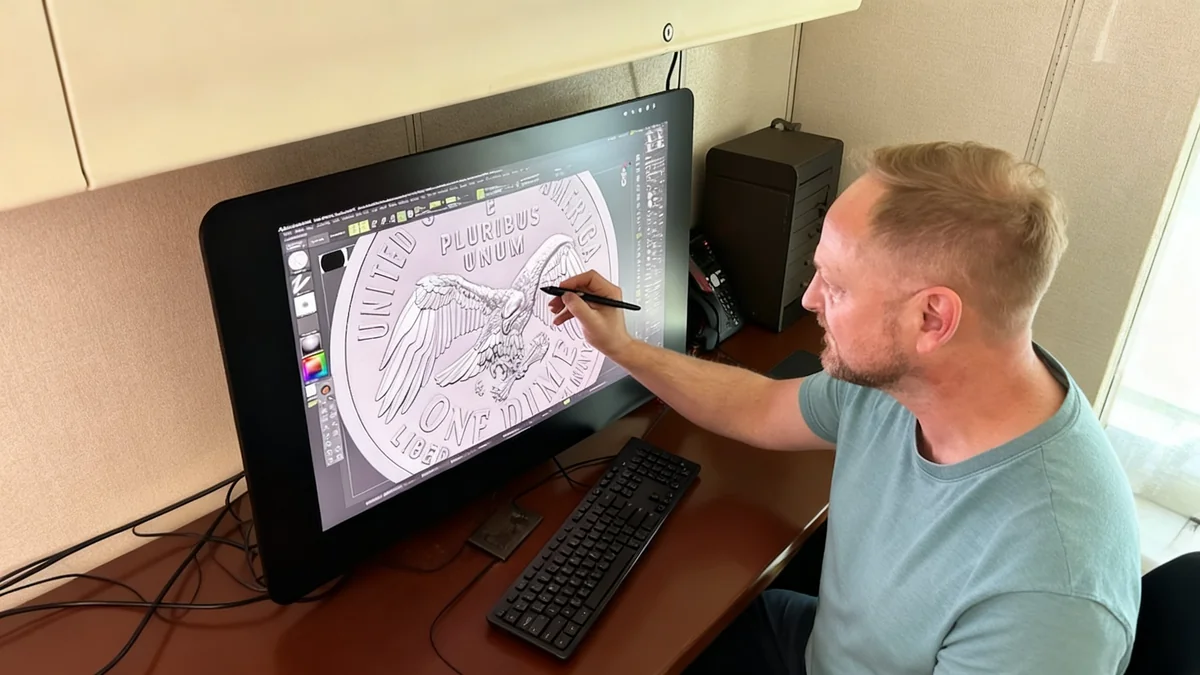
Today's medallic artists blend time-honored techniques with cutting-edge technology. While traditional clay sculpting is still part of the process, digital design software has become an essential tool. Artists can now create and refine their intricate designs on a computer, allowing for precise adjustments to details that might be mere fractions of a millimeter on the final coin.
This digital-first approach allows for greater flexibility and detail. Artists can experiment with textures, depths, and lettering in ways that were once incredibly time-consuming. Once a digital design is finalized, it is used to create a larger-than-life model, which is then digitally scanned and reduced to create the final coin die.
Fact: From Large to Small
Coin designs are typically sculpted at a much larger scale, often 10 to 12 inches in diameter, before being digitally shrunk to the actual coin size. This allows artists to work on fine details that would be impossible to see at the final scale.
Spotlight on the Artist: Eric David Custer
Among the talented team in Philadelphia is Medallic Artist Eric David Custer. His work exemplifies the modern approach to coin design, where artistic vision meets technical precision. Custer is one of the artists shaping the future of American currency, one design at a time.
One of his recent projects includes a design for the tails side of the upcoming semiquincentennial dime. This coin is part of a series planned to celebrate the 250th anniversary of the United States. Creating a design for such a significant commemoration carries immense pressure to produce something that is both historically meaningful and visually compelling.
"Every coin is a piece of public trust. Our job is to create something that not only functions as currency but also inspires a sense of pride and connection to our nation's story. It's a responsibility we take very seriously."
Custer's work, viewed on his computer screen during the design phase, shows a complex interplay of symbols and text, all carefully arranged to be clear and legible on a coin less than an inch in diameter. This is the daily challenge for the Mint's artists: balancing artistic expression with the practical demands of minting.
The Enduring Power of Physical Currency
In an increasingly digital world, the art of coin design remains profoundly relevant. Physical currency passes through millions of hands, acting as a tangible link to the nation's identity and values. Unlike digital transactions, a coin is a physical artifact that carries history with it.
The designs created in Philadelphia serve several purposes:
- Commemoration: They honor historical figures, celebrate national parks, and mark significant anniversaries.
- Education: For many, the images on coins are their first introduction to important people and events in U.S. history.
- Artistic Expression: They are a form of public art accessible to everyone, regardless of their background.
The work of the U.S. Mint's medallic artists ensures that this tradition continues. As they prepare for future commemorations, including the semiquincentennial, their skill and dedication will shape the small monuments that Americans carry with them every day, continuing a legacy of artistry that fits in the palm of your hand.