
David Lynch, known for his distinctive cinematic vision, maintained a lifelong connection to painting and other visual arts. New exhibitions are set to showcase this lesser-known but equally unsettling aspect of his creative output, beginning in Berlin before moving to Los Angeles.
Key Takeaways
- David Lynch started his artistic journey as a painter at age 14.
- His art career paralleled his filmmaking, driven by a desire for 'moving pictures'.
- Pace Gallery will host an exhibition in Berlin, followed by a larger survey in Los Angeles.
- The Berlin show opens in a former gas station, reflecting Lynch's fascination with industrial spaces.
- Exhibits will include paintings, photographs of factories, and unique light sculptures.
Early Artistic Beginnings and Influences
David Lynch's artistic path began early. He established his own art studio by the age of 14. At 18, he secured a spot to study painting at the School of the Museum of Fine Arts, Boston. However, he found the environment too rigid and soon withdrew.
His artistic journey continued at the Pennsylvania Academy of the Fine Arts. Here, Lynch found inspiration in Philadelphia's industrial landscape. He described the city's terrain as 'soot-belching' and its atmosphere as 'corrupt, fear-ridden.' This gritty aesthetic would become a recurring motif in his work.
From Canvas to Screen
Lynch's transition into film started during his art school days. While working on an easel late one night, he imagined the leaves in his painting moving, accompanied by the sound of wind. This moment sparked the idea of a 'moving painting,' leading to his first film. It was a one-minute animated loop featuring vomiting heads and a siren soundtrack.
For Lynch, painting and filmmaking were not separate disciplines. He saw them as connected, emerging from the same 'ocean of pure vibrant consciousness.' Genevieve Day of Pace Gallery, which represented Lynch, emphasizes this connection. She states that "With photography, with film, with sculpture; with every sort of medium you can imagine, everything for him related back to this practice of imagination that started with painting."
Exhibitions in Berlin and Los Angeles
Pace Gallery is preparing an exhibition of Lynch's work in Berlin. This show will coincide with what would have been his 80th birthday. The gallery and Lynch had already started planning the exhibition before his death last year.
The Berlin exhibition will be held in a former gas station. This architectural choice resonates with Lynch's lifelong fascination for raw industrial spaces. He developed this interest in 1960s Philadelphia and sought similar environments, even visiting the north of England for its 'hell-like, fire and smoke and power.'
A Glimpse into the Exhibits
- New photographs of desolate old factories in Berlin will debut.
- Three functional standing lamps, or 'sculptures with light components,' will be on display.
- These lamps are crafted from diverse materials including wood, steel, resin, Plexiglas, and plaster.
Following the Berlin show, a larger survey of his work is planned for the autumn in his hometown of Los Angeles. These exhibitions offer a comprehensive look at Lynch's artistic range beyond his celebrated films.
The Role of Light and Industrial Aesthetics
Light played a crucial role in Lynch's creative output, both on screen and in his sculptures. His films often use light to create dream-like, darkly comic, and sinister atmospheres. For example, flashing lights in Mulholland Drive (2001) signal shifts between realities. In his 1977 debut feature, Eraserhead, chiaroscuro lighting transforms an old steam radiator into an imposing, cathedral-like structure.
"With photography, with film, with sculpture; with every sort of medium you can imagine, everything for him related back to this practice of imagination that started with painting," says Genevieve Day of Pace Gallery.
Lynch's distinctive lamps are more than just functional objects. They are sculptural pieces that integrate light as a core component. One such floor lamp, used in Twin Peaks: The Return (2017) for the Sheriff's Department, recently sold at auction for $26,000. This highlights the collector's interest in his unique art objects.
The Impact of Twin Peaks and Lynchian Drama
The original series of Twin Peaks, which aired in 1990, captivated audiences and redefined serial television drama. Approximately 35 million Americans tuned in to watch, showcasing its profound cultural impact. The show brought a new sense of artistic freedom and complexity to the genre.
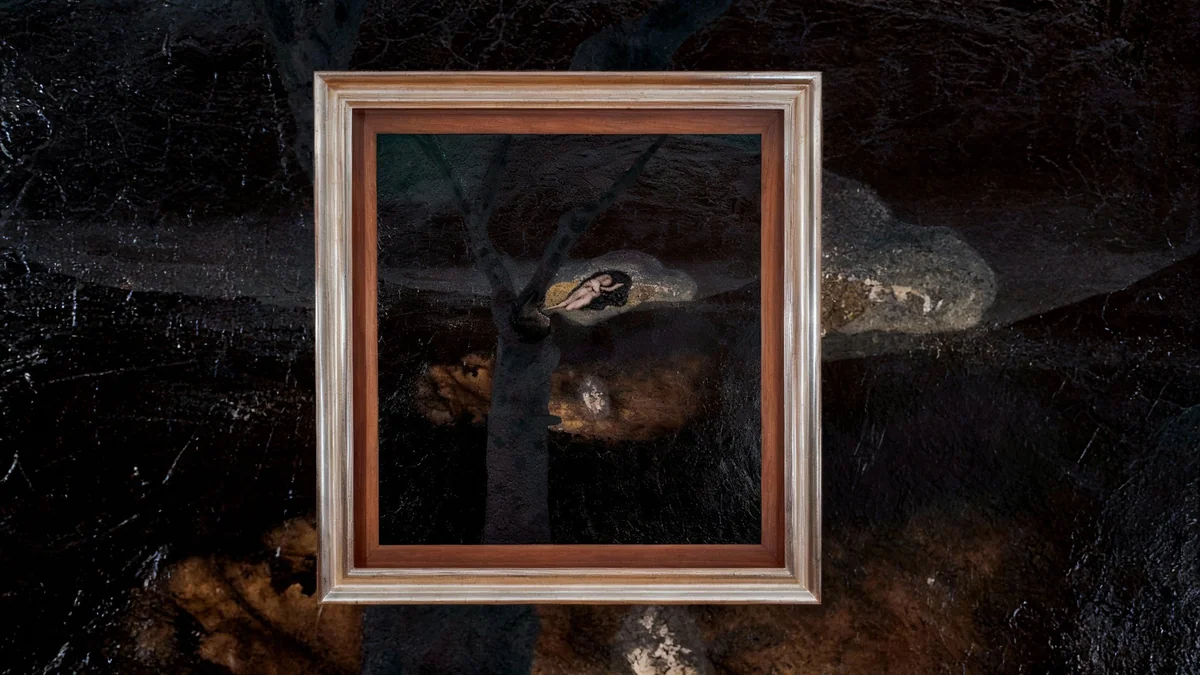
Many contemporary dramas, such as The Sopranos, The X-Files, and Desperate Housewives, draw inspiration from the 'Lynchian' principle. This principle suggests that beneath the calm surface of suburban life, dark and unusual elements often lurk. Lynch's paintings also reflect this unsettling quality, featuring strange characters, ambiguous phrases, and distorted surfaces.
Unsettling Images, Not Negative
Bill Griffin of Pace Gallery notes that while Lynch's paintings are unsettling, Lynch himself did not view them as negative. They delve into the subconscious, a realm Lynch was always curious about. This approach goes beyond surrealism, drawing from his inner world and the broader universe.
The Creative Process and Legacy
Sabrina Sutherland, Lynch's longtime producer, shared insights into his creative process. She described his 'daydreaming' as an active form of work. "One of his big things," she explains, "was to just sit and seemingly space out and daydream. That was an act of work for him, and important to him. He was thinking, but it was active, concentrated thinking; really figuring out the next step."
On set, Sutherland's role was to bring Lynch's precise visions to life. He often had a clear image in mind, detailing it meticulously. If an unusual object, like 'hot dogs and a spatula in the middle of the woods,' was hard to find, Lynch was always adaptable. He believed there were "a thousand ways to skin a cat" and fostered a collaborative environment, respecting every crew member.
Lynch often credited his mother for fostering his imagination. She encouraged him to draw and paint freehand, never using coloring books. An artist father of a high school friend also served as an early mentor. Bill Griffin highlights Lynch's unwavering commitment from a young age: "Boom: 'this is what I am and what I wanna do' — and that threaded through his entire life."
Art World Recognition
- Actor Isabella Rossellini introduced Lynch to prominent New York dealer Leo Castelli.
- An exhibition at Castelli's SoHo gallery in 1989 solidified Lynch's standing in the art world.
- His work has been shown globally, including a 40-year retrospective at Fondation Cartier in Paris (2007).
- The largest exhibition featured 500 works at Maastricht's Bonnefanten Museum (2018).
Sabrina Sutherland remembers Lynch as a dedicated individual who was always creating. "David never took a moment really for himself," she says. "He was always working, whether it was painting or building something. I mean, if your shoe broke, he'd want you to bring it in so he could fix it." His exhibitions now offer new insights into the breadth of his artistic genius.