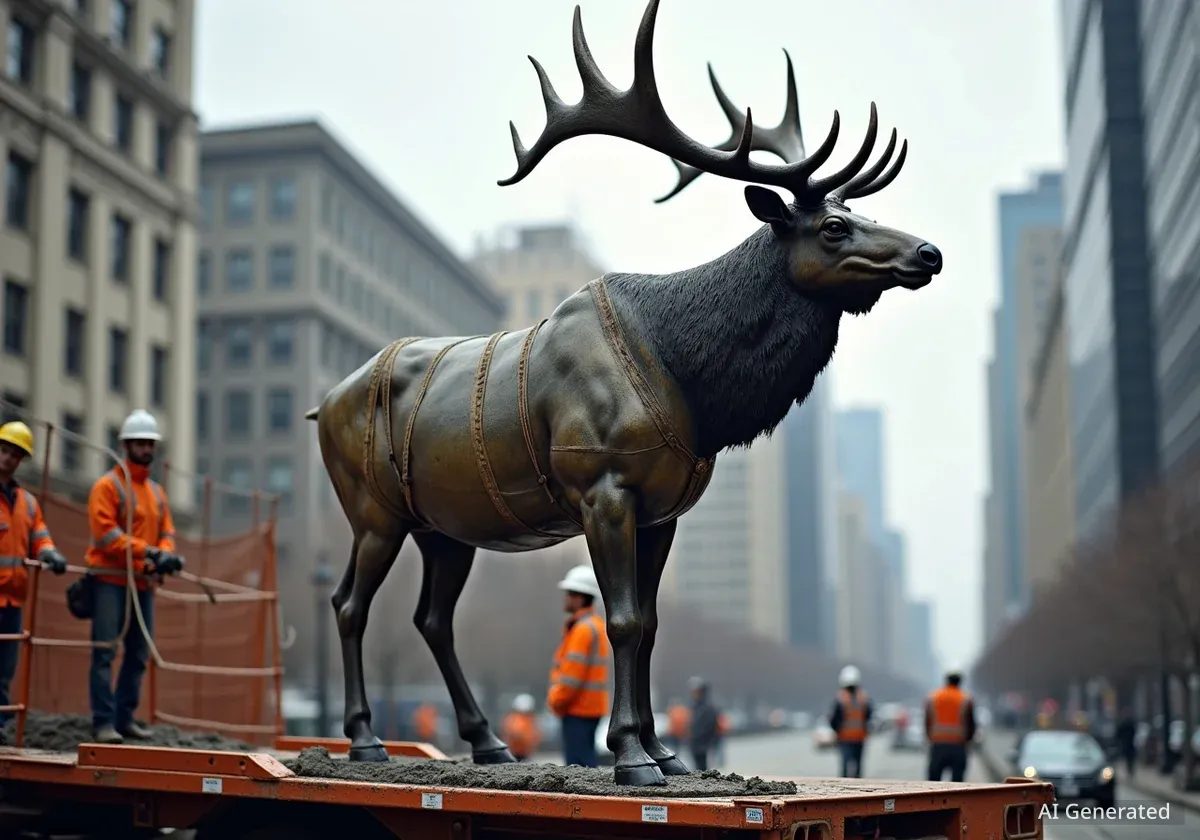

Portland's iconic Thompson Elk statue is set to return to its downtown home by spring 2026. The statue, removed in July 2020 after sustaining damage during protests, is undergoing extensive restoration and will feature a modern, sustainable fountain system. City officials and community members anticipate its homecoming as a symbol of hope and resilience for the city.
Key Takeaways
- The Thompson Elk statue will return to downtown Portland by spring 2026.
- Restoration efforts address damage from 2020 protests, including fire and graffiti.
- The project involves multiple city bureaus and a non-profit fundraising campaign.
- A new, sustainable fountain system will recycle water, saving millions of gallons annually.
- Total restoration cost is estimated at $2.2 million, with $1.8 million approved by the city.
The Journey Back Home
The bronze elk statue, a fixture at Southwest Main between 3rd and 4th Avenues since 1900, has been absent from its pedestal for over four years. Its removal in July 2020 followed incidents of graffiti and fires set within its fountain base. These events caused significant cracks in the granite, raising concerns about the structure's integrity.
City authorities have been keen to reinstate the monument. The process, however, has been complex, involving a collaboration of several organizations. These include the Portland Water Bureau, the Portland Office of Arts & Culture, the Portland Parks Foundation, and the Bureau of Transportation, among others.
Did You Know?
The Thompson Elk statue was donated by former Portland Mayor David Thompson in 1900. It honored the elk that once roamed the area and the Oregon Humane Society, which Thompson co-founded.
The statue itself, sculpted by Roland Hinton Perry, sustained less damage than initially feared. This was largely due to two layers of protective wax applied in the 1990s. Fine art conservator Robert Krueger has since cleaned the bronze using high-pressure carbon-dioxide crystals, effectively removing the old wax and graffiti.
Modernizing the Fountain and Base
A significant part of the restoration focuses on the fountain and its base. David O’Longaigh from the Portland Water Bureau highlighted the need for a new design. The original fountain was not sustainable, consuming nearly 6 million gallons of water annually, which then drained into the river.
"The original fountain ran almost 6 million gallons a year to drain into the river," O’Longaigh stated. "That will not happen anymore."
The new system will be a closed loop, recycling water continuously. This modern approach requires new power infrastructure, watertight membranes, and freshly carved granite. The stonework for the base is being sourced from the original quarry in Vermont, ensuring historical accuracy and aesthetic consistency.
A Witness to History
For 120 years, the Thompson Elk statue has stood as a silent observer to significant historical events. It has witnessed two world wars, two pandemics, and an estimated 33 major political protests, ranging from early 20th-century women's suffrage marches to the racial justice demonstrations of 2020.
Beyond sustainability, the new foundation will be reinforced for improved seismic stability. Modern plumbing and enhanced lighting will also be installed. This will allow the fountain to be enjoyed by visitors both day and night.
Funding and Community Sentiment
The total cost for the statue's return is estimated at approximately $2.2 million. While the statue was insured for $700,000, additional funds were necessary. The city has approved $1.8 million for the project, and a nonprofit organization has been established to raise further money for the restoration efforts.
The statue holds a special place in the hearts of many Portlanders. Its depiction of an animal, rather than a historical figure, has allowed it to largely avoid the political controversy sometimes associated with public monuments.
Darion Jones, with the city’s Office of Arts and Culture, expressed the widespread sentiment: "The elk is returning home and we’re all excited for its homecoming. We’re looking forward to seeing it back on that fountain."
Jones emphasized the symbolic importance of the elk's return. "I can tell you that the elk has always been a monument that had little conversation in terms of protests against it," he explained. "Seeing that elk return, I do think it is hope returning back to our city."
Changes to the Surrounding Area
The area around the statue will also see a permanent change. Before its removal in 2020, two vehicle lanes flanked the monument. Hannah Schafer, from the Portland Bureau of Transportation, confirmed that one of these lanes has been converted into a dedicated bike lane and will remain so.
"The addition of a bike lane has really served people who are cycling for a couple of years now and been very helpful," Schafer noted. This adjustment reflects Portland's ongoing commitment to urban planning that prioritizes sustainable transportation options.
The return of the Thompson Elk statue marks a significant moment for downtown Portland. It represents not only the restoration of a beloved landmark but also a step forward in urban development and community spirit.