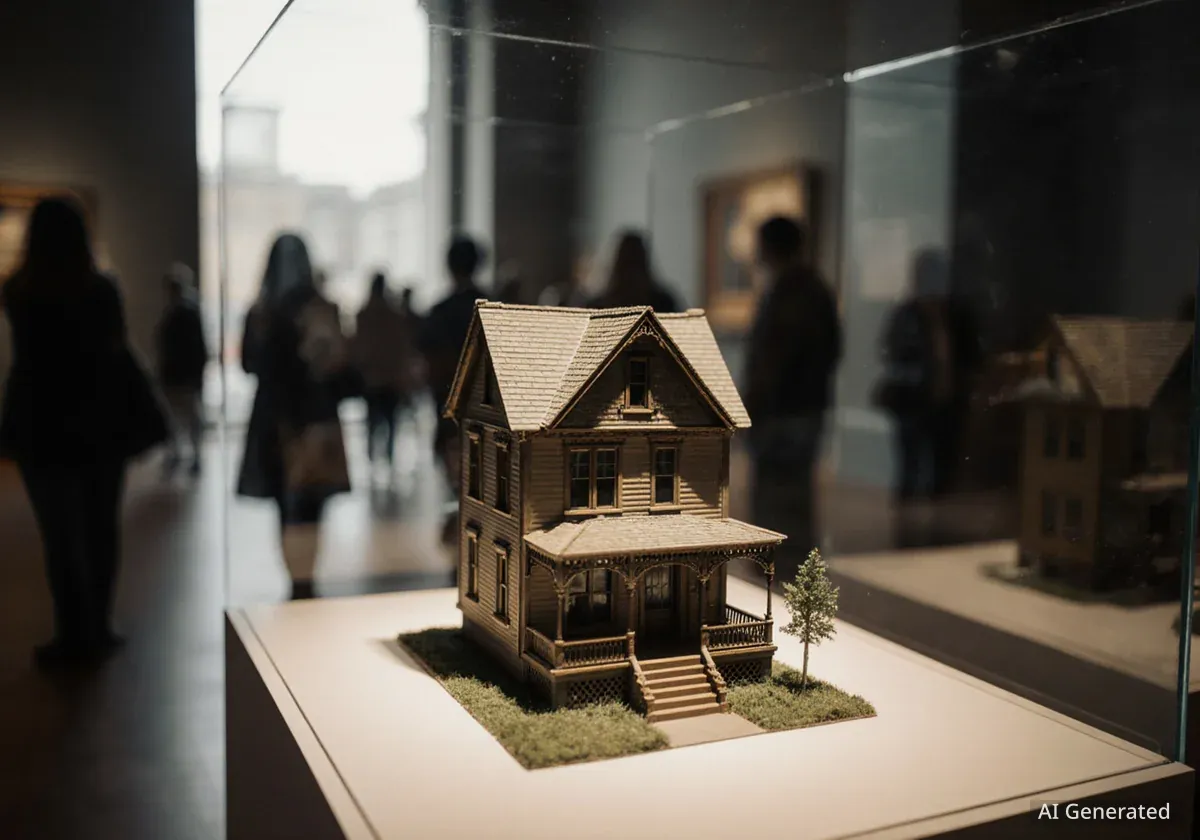
An 85-year-old Eureka resident, Eddie Serna, has dedicated nearly three decades to meticulously crafting miniature replicas of the city's iconic Victorian houses. These intricate façades, each standing about two feet tall, capture the unique architectural details of real homes found throughout Eureka.
Serna's passion for these miniature structures began in the mid-1980s, inspired by his sister, Antoinette. His work has since become a cherished part of the local art scene, with many of his pieces currently on display at the Clarke Museum in Old Town.
Key Takeaways
- Eddie Serna, 85, creates miniature Victorian house façades, replicating real Eureka homes.
- His craft began 30 years ago, inspired by his late sister, Antoinette.
- Serna focuses on preserving the image of older, less pristine houses.
- His work is exhibited at the Clarke Museum and Humboldt County Library.
- A GoFundMe campaign is active to help cover the rising costs of materials.
A Lifelong Dedication to Miniature Architecture
Eddie Serna's journey into miniature craftsmanship started unexpectedly. While caring for his ailing sister, Antoinette, he discovered a book titled "Painted Ladies: San Francisco's Resplendent Victorians." The book captivated him, especially a quote from his sister on the front page:
“I love these old Victorians.”This phrase sparked his initial desire to recreate these beautiful homes.
Initially, Serna made each miniature entirely by hand. He would carve, sand, and paint tiny shingles and adornments. This process required immense patience and taught him the importance of precision. He often emphasizes that his most crucial tools are his combination square and compass, essential for ensuring everything is built correctly.
Interesting Fact
Eddie Serna's miniatures are façades, not full replicas, because his initial inspiration came from photographs where he could only see the front of the houses.
Evolution of the Craft
Over the years, Serna's methods have evolved. While he still custom-makes many components, he now sources some structural materials like shingles and siding online. This change has made the process more efficient and cost-effective, allowing him to create more detailed and accurate representations of Eureka's Victorian heritage.
He moved to Humboldt County in the early 1990s and worked at the Blue Ox Millworks, further refining his woodworking skills. After retiring about 13 years ago, he returned to Humboldt and dedicated himself fully to his miniature art.
Preserving Eureka's Architectural Heritage
Serna's selection process for which houses to replicate is unique. He often walks through Eureka's neighborhoods, taking photographs of homes that catch his eye. He particularly seeks out older, less maintained houses, driven by a desire to preserve their image before they potentially deteriorate or are lost.
“I want to take pictures of these old house before they fall apart or burn,” Serna explained. “I’m taking pictures of those first because I want to save them by making a model of them.”
While he initially focuses on these "shabby" homes, he plans to eventually create models of more prominent and expensive Victorians. This approach highlights his commitment to showcasing the full spectrum of Eureka's architectural landscape, not just the most famous examples.
Background Information
Eureka, California, is renowned for its well-preserved Victorian architecture, particularly in areas like Old Town. These homes feature distinctive styles such as Queen Anne, Stick-Eastlake, and Italianate, characterized by intricate detailing, towers, turrets, and vibrant paint schemes.
Community Impact and Museum Display
Serna's work has resonated deeply within the community. His miniatures are currently on display at the Clarke Museum, where they have become a significant attraction. Dana Fredsti, the museum’s marketing and events coordinator, described Serna as a "sweetheart" whose enthusiasm for his models is "contagious."
Shawn Wagner, Executive Director of the Clarke Museum, shared her admiration for Serna's artistry. She recounted their first meeting, where Serna meticulously described each model, detailing the pieces used, the time invested, and the inspiration behind each house. Wagner noted that Serna’s models have become a "pivotal part of the museum," embodying the spirit of Eureka.
Museum staff are actively working with Serna to identify the addresses of all the houses he has replicated, though a few still remain a mystery, including one believed to be on C Street.
Facing Challenges and Seeking Support
Despite his dedication, Serna faces challenges. The rising cost of materials, coupled with his fixed income, has made it difficult to continue his craft at the same pace. His therapist, Angelina Torres, recognized the importance of his work and helped him establish a GoFundMe campaign to secure necessary funds.
Torres expressed her belief in the community's support for Serna:
“When I first learned that Eddie was recreating these Victorians on his own — even while living on a fixed income — I was amazed and impressed. That drove my own passion to help him because I believe we live in a wonderful community, and if other community members knew of his story, that would also inspire others to help him by donating.”
- The GoFundMe aims to cover material costs and update some of Serna's machinery.
- Donations help Serna continue his artistic and healing journey.
- His miniatures are available for public viewing at the Clarke Museum and the Humboldt Room of the Humboldt County Library.
Torres views Serna's art as more than just a personal triumph. She sees it as a way for him to share his healing journey with the world, creating art that "heals, that transforms, and that uplifts, art that speaks to those of us who need it most." The community's support is crucial for Serna to continue his unique contribution to preserving Eureka's architectural legacy.