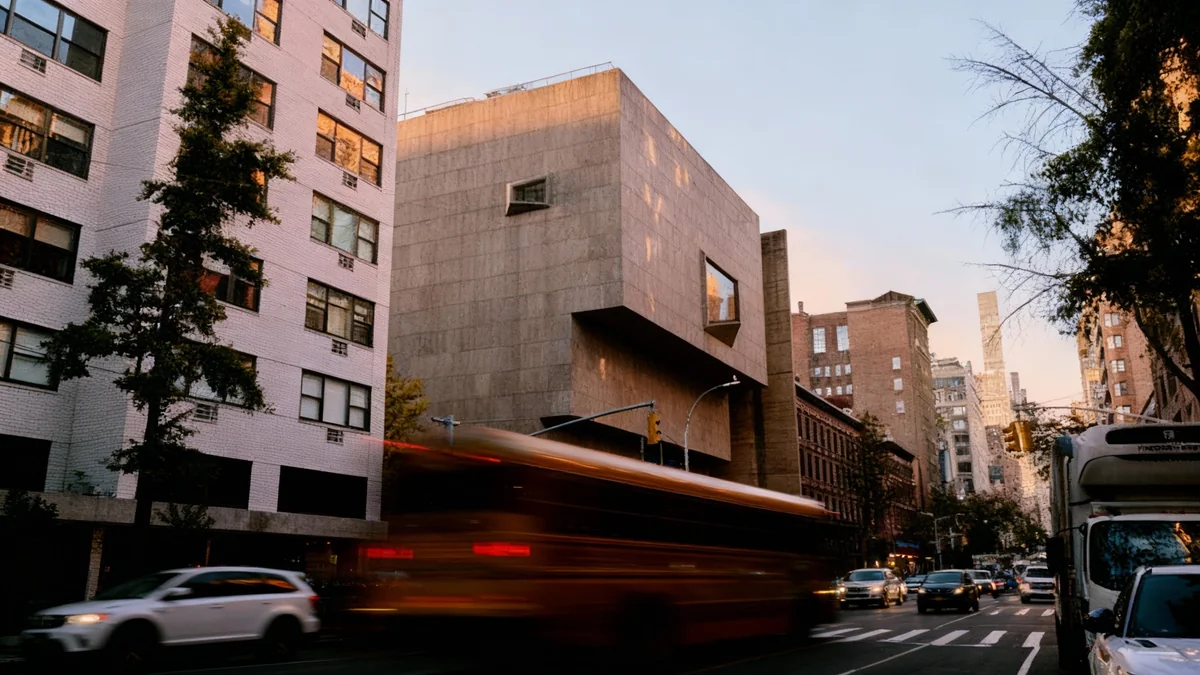

Sotheby's, the renowned auction house, will open its new global headquarters on November 8 in the iconic Marcel Breuer building on Madison Avenue. This marks a significant new chapter for the Brutalist landmark, which previously housed the Whitney Museum of American Art. The renovation, led by Herzog & de Meuron, focused on respectful preservation and subtle enhancements, ensuring the building's distinctive character remains intact.
The $100 million acquisition by Sotheby's two years ago brought a sense of relief to preservationists. Concerns had circulated within art and architectural circles that the building might be drastically altered or converted for commercial retail purposes. Instead, the auction house has opted for a thoughtful restoration, maintaining much of the original design while adapting it for its new function.
Key Takeaways
- Sotheby's new headquarters opens November 8 in the former Whitney Museum building.
- The Marcel Breuer-designed Brutalist structure underwent a $100 million renovation.
- Herzog & de Meuron led the renovation, focusing on preservation and subtle changes.
- The building, once criticized, is now a recognized city landmark.
- Entry to view art at Sotheby's will be free to the public.
A Controversial Landmark Reimagined
When the Breuer building first opened in 1966, it polarized public opinion. Ada Louise Huxtable, a prominent architecture critic, famously called it "the most disliked building in New York." Its gray granite facade and concrete walls gave it a fortress-like appearance, a stark contrast to its Upper East Side neighbors. The structure, an upside-down ziggurat, seemed to recede from Madison Avenue behind a dry moat, creating a defensive posture.
Despite early criticism, the building slowly gained appreciation. Its lobby, crafted from slate, stone, and bush-hammered concrete, offered a sense of cool, understated luxury. The intimate scale and sculptural finesse of the interior were particularly noted. By the early 1980s, the building was designated a city landmark, a testament to a shift in public and professional perception.
Building History at a Glance
- 1966: Marcel Breuer building opens as the Whitney Museum of American Art.
- Early 1980s: Designated a New York City landmark.
- 2015: Whitney Museum relocates to a new building in the Meatpacking District.
- 2015-2023: Building leased by other institutions, including The Met and The Frick Collection.
- 2023: Sotheby's purchases the building for $100 million.
- November 8, 2025: Reopens as Sotheby's new global headquarters.
Preserving Breuer's Vision
The architectural firm Herzog & de Meuron, known for their meticulous approach, oversaw the renovation. Their work focused on steam-cleaning the original walls and restoring certain elements. Several galleries that had been converted into offices are now returned to their original purpose, allowing for more exhibition space. The rooms are now flexible and predominantly white, creating a neutral backdrop for art.
Key architectural details, such as the axial views of Breuer’s trapezoidal, gun-port windows, have been carefully restored. These windows offer unique perspectives of Madison Avenue and the surrounding urban landscape. The design choices underscore a deep respect for Breuer's original intent while adapting the space for modern auction house operations.
"The renovation is thoughtful and deeply respectful, with a stress on materiality and crisp detail," a spokesperson for the project stated.
Subtle Modernizations
While preserving the building's historic fabric, some strategic modernizations were introduced. A fifth-floor mezzanine has been transformed into a VIP skybox, offering clients a discreet vantage point to observe live auctions through mirrored glass. This addition provides a contemporary amenity without detracting from the building's aesthetic.
In the landmarked lobby, sleek glass vitrines have been integrated into Breuer's built-in concrete furniture. These vitrines, while new, are designed to be inconspicuous and reversible, maintaining the integrity of the original design. They provide functional display areas for art without permanent alteration to the historic elements.
Breuer's Legacy and Preservation
Marcel Breuer, a prominent Brutalist architect, played a surprising role in the history of historic preservation in the United States. In 1978, a U.S. Supreme Court ruling, Penn Central Transportation Co. v. City of New York, upheld New York City's preservation law. This landmark decision prevented the Penn Central Transportation Company from erecting an office tower atop Grand Central Terminal. Ironically, the architect behind that controversial skyscraper proposal was Marcel Breuer himself. This ruling paved the way for preservation laws across all 50 states and over 500 municipalities.
Operational Enhancements for Sotheby's
One major structural alteration, a new service elevator on the north end, addresses a critical logistical need for Sotheby's. This elevator, while taking a small slice of original gallery space, is crucial for moving the vast amount of art the company handles. It is designed to be largely unnoticeable to the general public, primarily serving behind-the-scenes operations and whisking VIP clients to the new skybox.
PBDW Architects collaborated with Herzog & de Meuron as architects of record, ensuring all alterations complied with the strict guidelines of the Landmarks Preservation Commission. This partnership highlights the complex balance between functional requirements and historical preservation.
Free Access to Art
Perhaps the most significant change for the public is the new access policy. Unlike its previous incarnation as a ticketed museum, entry to Sotheby's new headquarters will be free. This means anyone can walk in and peruse the art on display, even if it is for sale. This shift democratizes access to art, allowing a wider audience to experience works that might otherwise be seen only by collectors.
The building's journey from a controversial new structure to a cherished landmark, and now to a publicly accessible art space, reflects an evolving appreciation for its unique architecture and its role in New York City's cultural landscape. The transformation by Sotheby's ensures this Brutalist masterpiece will continue to serve the art world for decades to come.