
Paris’s iconic Louvre Museum closed its doors to thousands of visitors on Monday as staff initiated a strike. The action protests ongoing security failures, severe overcrowding, and deteriorating working conditions at the world's most visited museum. This marks another significant challenge for the institution, coming nearly two months after a high-profile jewel heist.
Key Takeaways
- Louvre Museum staff went on strike due to security concerns, overcrowding, and poor working conditions.
- The strike follows a $102 million crown jewel heist in October, highlighting existing security vulnerabilities.
- Approximately 400 employees voted to continue the strike, representing diverse departments.
- The museum faces criticism for managing over 30,000 daily visitors, exceeding planned capacity.
- A major renovation plan, estimated at up to $940 million, is underway to address structural issues.
Museum Closure Disappoints Thousands of Tourists
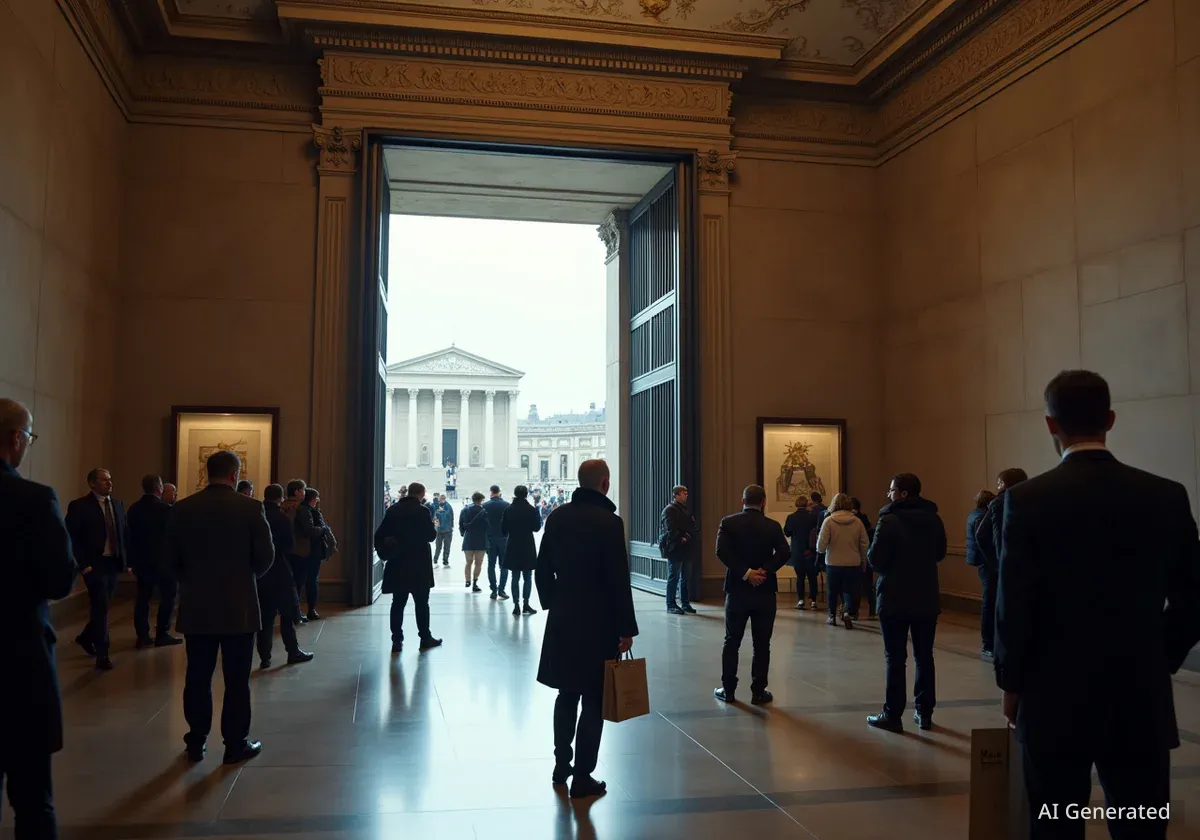
Early Monday morning, visitors arriving at the Louvre were met with closed doors. A security agent informed them the museum was shut, advising them to return later. This closure impacted thousands of tourists who had planned their visits to the famed Parisian landmark, many traveling internationally specifically to see its collections.
Minsoo Kim, 37, on his honeymoon from Seoul, expressed his disappointment. He stated, "I'm very disappointed, because the Louvre was the main reason for our visit in Paris, because we wanted to see the 'Mona Lisa'." Natalia Brown, a 28-year-old tourist from London, echoed the sentiment but also understood the staff's reasons. "At the same time, I understand why they're doing it, it's just unfortunate timing for us," she noted.
Louvre Visitor Statistics
- The Louvre welcomes several million visitors beyond its planned capacity each year.
- It handles an average of 30,000 visitors daily.
- A spontaneous walk-out in June led to a temporary closure earlier this year.
Widespread Staff Discontent Fuels Strike Action
The decision to strike was not taken lightly. Around 400 employees voted unanimously at a general meeting to continue their industrial action. This widespread support comes from various departments, as highlighted by Christian Galani of the CGT union.
"We're going to have a lot more strikers than usual," Galani stated. "Normally, it's front-of-house and security staff. This time, there are scientists, documentarians, collections managers, even curators and colleagues in the workshops telling us they plan to go on strike."
This shows a broad spectrum of grievances. Reception and security staff consistently report being understaffed, struggling to manage the immense crowds. Documentarians and curators are increasingly concerned about the physical state of the former royal palace, citing issues like recent water leaks and gallery closures due to structural damage.
Security Lapses Following Crown Jewel Heist
The strike follows a major security incident on October 19, when crown jewels valued at $102 million were stolen in broad daylight. This embarrassing heist brought existing security vulnerabilities into sharp focus. Investigations revealed critical failures during the incident.
Intruders used an extendable ladder to reach a gallery, then cut through a glass door with angle grinders. At the time of the robbery, only one security camera was operational outside the targeted area. Guards in the control room lacked sufficient screens to monitor all surveillance footage in real-time, and police were initially misdirected by faulty information.
Previous Warnings Ignored
Multiple studies over the past decade warned Louvre management about security weaknesses. A 2019 audit by experts at the jewelry company Van Cleef & Arpels specifically identified the riverside balcony as a weak point, easily accessible with an extendable ladder. This exact scenario played out during the recent heist, raising questions about why these warnings were not adequately addressed.
Overcrowding and Deteriorating Facilities
Beyond security, staff complaints center on the sheer volume of visitors. The museum, home to masterpieces like the 'Mona Lisa,' attracts millions more people than its infrastructure was designed to handle each year. Unions describe the daily experience for the 30,000 visitors as an "obstacle course" due to long queues, overcrowded galleries, and substandard amenities such as toilets and catering services.
The physical condition of the building itself is a growing concern. Chief Louvre architect Francois Chatillon acknowledged the issues during a parliamentary hearing last month, admitting, "The building is not in a good state." Louvre boss Laurence des Cars also highlighted problems with leaks and overheating in a memo to the government earlier this year.
Government Response and Renovation Plans
In response to these mounting issues, French President Emmanuel Macron announced a significant renovation plan for the museum in January. This ambitious project is expected to cost between 700 million and 800 million euros, potentially reaching up to $940 million. The renovation aims to address the structural deficiencies and improve the overall visitor experience.
However, staff and union representatives believe immediate measures are also necessary to ensure safety and improve working conditions. They argue that long-term renovation plans do not resolve the immediate challenges of understaffing and security gaps that put both staff and priceless collections at risk.
- Increased Staffing: Unions demand more personnel for security and front-of-house roles.
- Enhanced Security: Calls for updated surveillance systems and adequate control room staffing.
- Visitor Management: Proposals to better manage visitor flow and reduce overcrowding.
- Facility Upgrades: Urgent repairs to address structural issues and improve amenities.
The ongoing strike underscores the deep-seated issues facing one of the world's most treasured cultural institutions. Resolving these challenges will require a comprehensive approach that prioritizes both the safety of its collections and the well-being of its dedicated workforce.