Several renowned architecture firms have submitted proposals for a major redesign of Washington Dulles International Airport (IAD). This initiative follows a request from the Department of Transportation (DOT) and comes after former President Donald Trump publicly criticized the airport's functionality, despite praising its original terminal design.
The submissions include detailed plans from global studios like Zaha Hadid Architects and Grimshaw, aiming to modernize the airport while largely preserving its historic Eero Saarinen-designed main terminal.
Key Takeaways
- Multiple top architecture firms have submitted redesign proposals for Washington Dulles Airport.
- Proposals aim to modernize the airport while largely preserving the historic Saarinen terminal.
- The Department of Transportation's request for information (RFI) sought solutions for the airport's operational inefficiencies.
- One proposal suggests renaming a new terminal the 'Donald J Trump Terminal'.
- Advocacy groups are expressing concerns about potential impacts on the historic 1962 Saarinen building.
The Call for Modernization at Dulles
The Department of Transportation issued a request for information (RFI) in early December 2025. This RFI invited proposals to either replace or build upon the existing main terminal and satellite concourses at Washington Dulles International Airport.
The move comes after significant public comments regarding the airport's operational challenges. Former President Trump described the airport as "terrible" and its terminals as "incorrectly designed." He did, however, acknowledge the beauty of the original Saarinen terminal.
"Actually, it's got a beautiful terminal – one of the greatest architects in the world at the time," he stated. "And so they have a great building and a bad airport, but we're gonna turn that around."
Airport Facts
- Washington Dulles International Airport (IAD) opened in 1962.
- Its main terminal was designed by renowned architect Eero Saarinen.
- The airport is located 26 miles west of downtown Washington, D.C.
Architectural Responses and Design Concepts
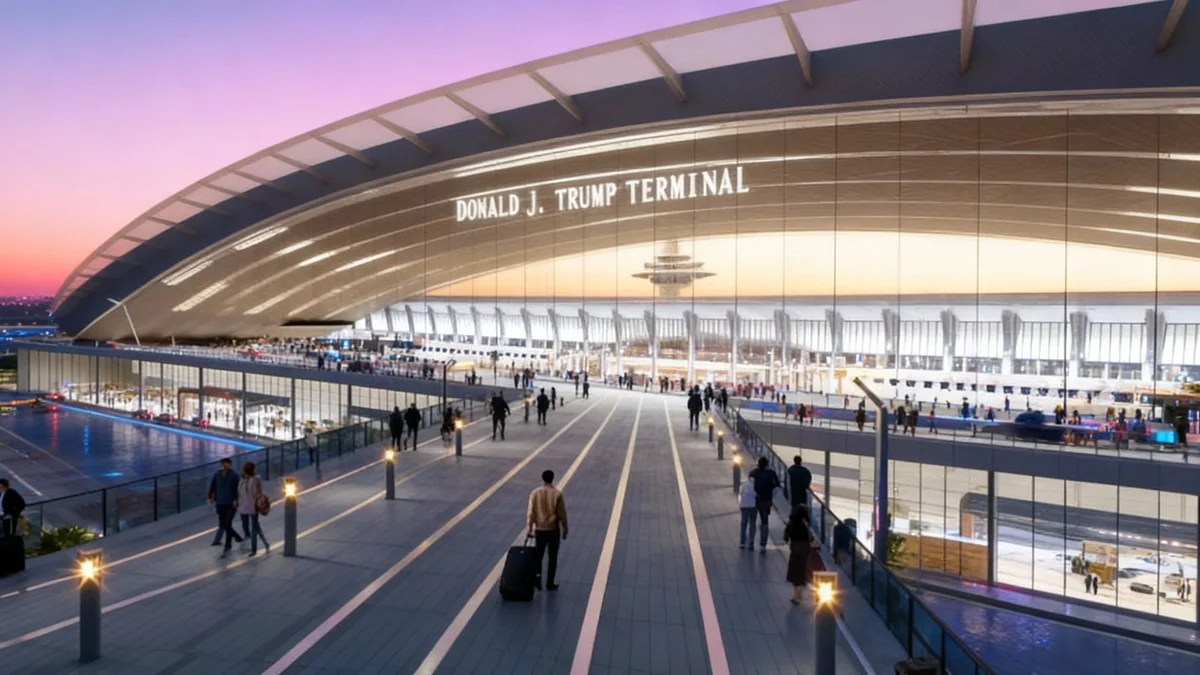
Among the notable submissions, a joint proposal from Bermello Ajamil & Partners and Zaha Hadid Architects stands out. Their renderings feature a new structure, prominently displaying the name "Donald J Trump Terminal." This aligns with ongoing efforts by some Republican lawmakers to rename the airport.
Another significant proposal comes from London-based Grimshaw, in partnership with infrastructure firm Ferrovial. Their design concept includes a dramatic, sweeping accordion ceiling structure. This proposal also features a comprehensive masterplan that reorganizes other airport facilities, such as parking structures.
Other firms, including AECOM and Adjaye Associates, submitted text-based proposals outlining their approaches, though without accompanying visual renderings of new designs.
Preserving the Saarinen Legacy
A central theme across many proposals is the preservation of the iconic Eero Saarinen-designed terminal. This 1962 building holds significant architectural and historical value.
The RFI itself noted the original terminal was "once known for its iconic aerofoil-inspired main terminal." However, it also highlighted current issues, stating the airport is "now better known for its inefficient system of people movers... its infamous moon-rover-like 'mobile lounges', jet fuel smell in the concourses, and a paltry number of gates at the main terminal." The document concluded that Dulles is "no longer an airport suitable and grand enough for the capital of the United States of America."
The Saarinen Terminal's Significance
Eero Saarinen's main terminal at Dulles is celebrated for its distinctive curved roof and innovative design. It is considered a masterpiece of mid-century modern architecture, reflecting the optimism and technological advancements of the early jet age.
Both the Bermello Ajamil & Partners / Zaha Hadid Architects scheme and the Grimshaw / Ferrovial design suggest maintaining the Saarinen building. Their proposals envision repurposing the historic terminal, potentially transforming it into a lounge or other commercially oriented use. AECOM’s proposal similarly suggested shifting the Saarinen building towards "revenue‑generating uses rather than adapting it to functions it was never intended to serve."
Concerns from Conservationists
The potential impact on the historic Saarinen building has drawn attention from conservation groups. Doconomo, a prominent organization dedicated to modern architecture conservation, responded to the RFI with "serious concern."
Their submission specifically expressed "serious concern regarding any revitalisation initiative that could result in the substantial alteration or demolition of Eero Saarinen's Main Terminal at Washington Dulles International Airport." This highlights the delicate balance between modernization and historical preservation.
Key Design Challenge
The main challenge for architects is to integrate new, efficient infrastructure while respecting the architectural integrity of the existing Saarinen terminal, which is a protected landmark.
Future Steps and Design Philosophy
The RFI explicitly mentioned consistency with former President Trump's "Making Federal Architecture Beautiful Again" executive order. However, the proposals from both Grimshaw/Ferrovial and Bermello Ajamil & Partners/Zaha Hadid Architects feature distinctly contemporary designs.
The window for RFI submissions has now closed. The Department of Transportation did not provide immediate comment on the submitted proposals. The next steps will involve evaluating these diverse design concepts to determine the best path forward for Washington Dulles International Airport's future.
The ultimate goal is to transform Dulles into an airport that meets the demands of modern air travel while honoring its unique architectural heritage. This ambitious project seeks to resolve long-standing operational issues and enhance the passenger experience at one of the nation's key international gateways.