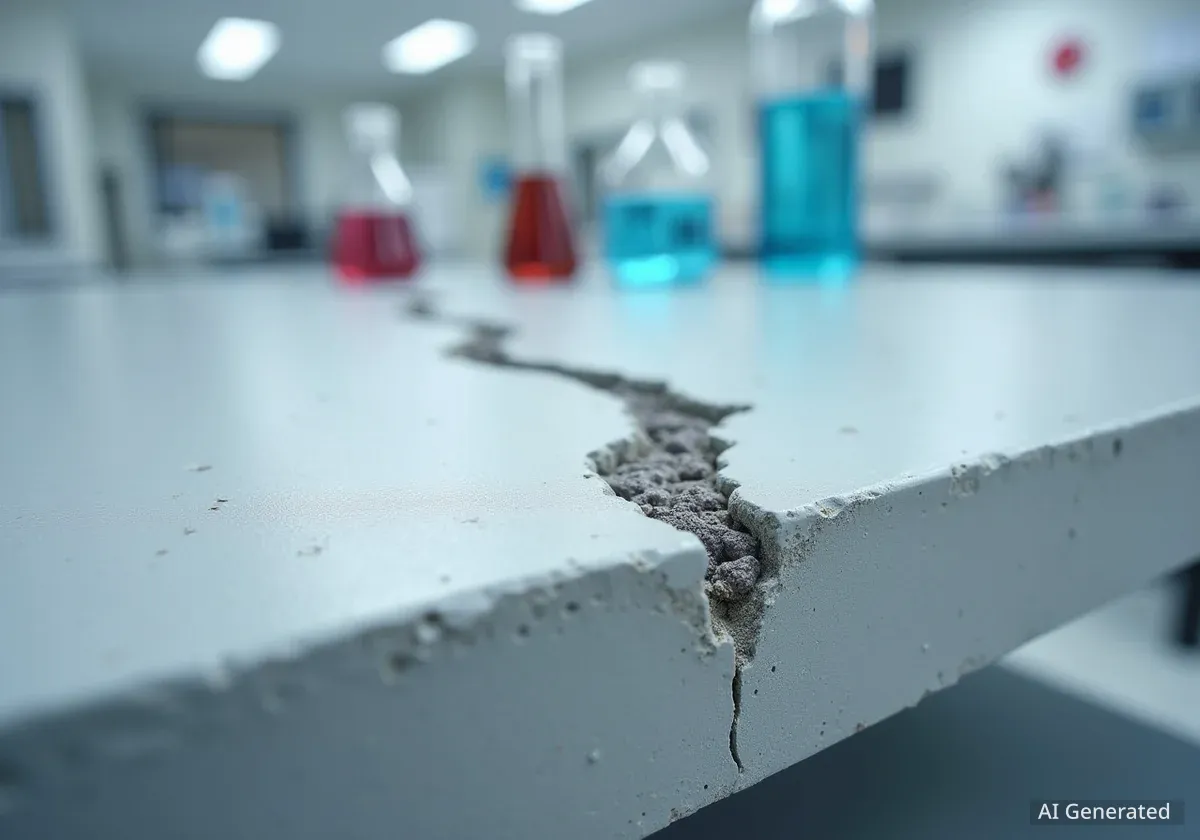




Researchers at the Northwood University Institute for Material Science have announced a significant breakthrough in construction technology with the development of a new self-healing concrete. The material, named NU-Crete, incorporates specialized bacteria that activate upon contact with water to produce limestone, effectively repairing cracks as they form. This innovation promises to extend the lifespan of infrastructure and dramatically reduce long-term maintenance costs.
The research, published in the latest issue of the Journal of Advanced Materials, details a new method for embedding dormant bacterial spores and their nutrient source within the concrete mix. According to the team, NU-Crete could potentially double the service life of structures like bridges, tunnels, and buildings, while also lowering the significant carbon footprint associated with concrete production and repair.
Key Takeaways
- Northwood University researchers have developed NU-Crete, a self-healing concrete that uses bacteria to repair cracks.
- The bacteria, Bacillus pseudofirmus, remain dormant until activated by water seeping into a crack, at which point they produce calcite (limestone) to seal the gap.
- Lab tests show NU-Crete can heal cracks up to 0.8 millimeters wide within 28 days, a significant improvement over previous bio-concretes.
- The technology could reduce infrastructure maintenance costs by an estimated 40-50% and lower the carbon emissions from concrete repair and replacement.
The Science of Living Concrete
The concept of self-healing concrete is not entirely new, but the Northwood University team has overcome several key limitations that hindered previous versions. The core of the technology lies in embedding specific, non-pathogenic bacteria into the concrete mixture.
Dr. Alisha Sharma, the lead researcher on the project, explained the process. "We selected a strain of bacteria, Bacillus pseudofirmus, that can survive in the highly alkaline environment of concrete," she stated. "These bacteria form spores and can lie dormant for decades, or even centuries, until they are needed."
How the Healing Process Works
The bacterial spores are mixed into the concrete along with biodegradable capsules containing calcium lactate, which serves as their food source. When a crack forms in the structure, two things happen simultaneously.
First, water and oxygen enter the crack, which is the trigger for the bacterial spores to germinate. Second, the crack ruptures the capsules, releasing the calcium lactate. The newly activated bacteria consume this nutrient and, through their metabolic process, precipitate calcite—a form of limestone—which fills the crack.
"Essentially, the concrete mimics a biological process. When it's 'injured,' it triggers a healing response to seal the wound. This autonomous repair mechanism could make our infrastructure far more resilient and durable," Dr. Sharma added.
The team's innovation lies in the protective capsules, which ensure the bacteria and their food source remain viable during the violent mixing process of concrete production and only become active when a crack actually occurs.
By the Numbers: NU-Crete Performance
- Healing Speed: Seals a 0.5mm crack in approximately 20 days.
- Maximum Crack Width: Can fully repair cracks up to 0.8mm.
- Durability: Spores remain viable for an estimated 200 years within the concrete matrix.
- Strength Regain: Healed sections recover up to 85% of their original structural strength.
Transforming Infrastructure Maintenance
The potential economic and safety implications of NU-Crete are substantial. Globally, governments and private entities spend hundreds of billions of dollars annually on repairing and replacing aging concrete infrastructure. This new material could fundamentally change that model from reactive repair to proactive, built-in maintenance.
According to a report from the Global Infrastructure Hub, corrosion and cracking in concrete are leading causes of structural failure. By autonomously healing these minor fissures before they can grow and compromise the structure, NU-Crete could prevent catastrophic failures and extend the operational life of critical assets.
Reducing Costs and Improving Safety
For structures like bridges, tunnels, and nuclear power plants, manual inspection and repair are costly, disruptive, and often dangerous. NU-Crete would significantly reduce the need for such interventions.
"Imagine a bridge that can heal its own microscopic cracks caused by traffic and weather," said project engineer Marcus Thorne. "You're not just saving money on patchwork; you're creating a safer structure that can withstand stress for much longer. We project a potential reduction in lifetime maintenance costs of up to 50% for many types of infrastructure."
The Problem with Traditional Concrete
Concrete is the most widely used man-made material in the world. However, its production is a major source of carbon dioxide, accounting for roughly 8% of global emissions. Furthermore, its tendency to crack under tension requires constant, costly maintenance and eventual replacement, adding to its environmental impact over its lifespan.
Environmental and Sustainability Benefits
Beyond the economic advantages, the environmental impact of NU-Crete is a key selling point. The global cement industry is one of the largest emitters of CO2. By creating more durable concrete that needs to be replaced less frequently, the demand for new cement production can be reduced.
The process of manufacturing cement involves heating limestone to extremely high temperatures, a highly energy-intensive process that releases vast amounts of carbon dioxide. Extending the life of a concrete structure by 50 or 100 years means a dramatic reduction in its overall carbon footprint.
"Sustainability in construction is about more than just using recycled materials," Dr. Sharma explained. "It's about longevity. The most sustainable building is one that you don't have to rebuild. That's the principle we're aiming for with NU-Crete."
Challenges and the Road to Commercialization
Despite the promising results, the team acknowledges there are hurdles to overcome before NU-Crete becomes a common sight on construction sites. The primary challenge is cost. The addition of bacterial spores and encapsulated nutrients currently increases the material cost of concrete by approximately 30-40%.
However, the researchers argue that the higher initial investment is more than offset by the massive savings in long-term maintenance. "When you analyze the total lifecycle cost of a structure, NU-Crete is actually the more economical option," Marcus Thorne noted. "We are now focused on scaling up production to bring that initial cost down."
The Northwood University team is partnering with several construction and materials companies to begin pilot projects over the next two years. These real-world tests will assess the material's performance in various climates and under different structural loads. If successful, NU-Crete could be commercially available within the next five to seven years, paving the way for a future of more durable, safer, and sustainable infrastructure.