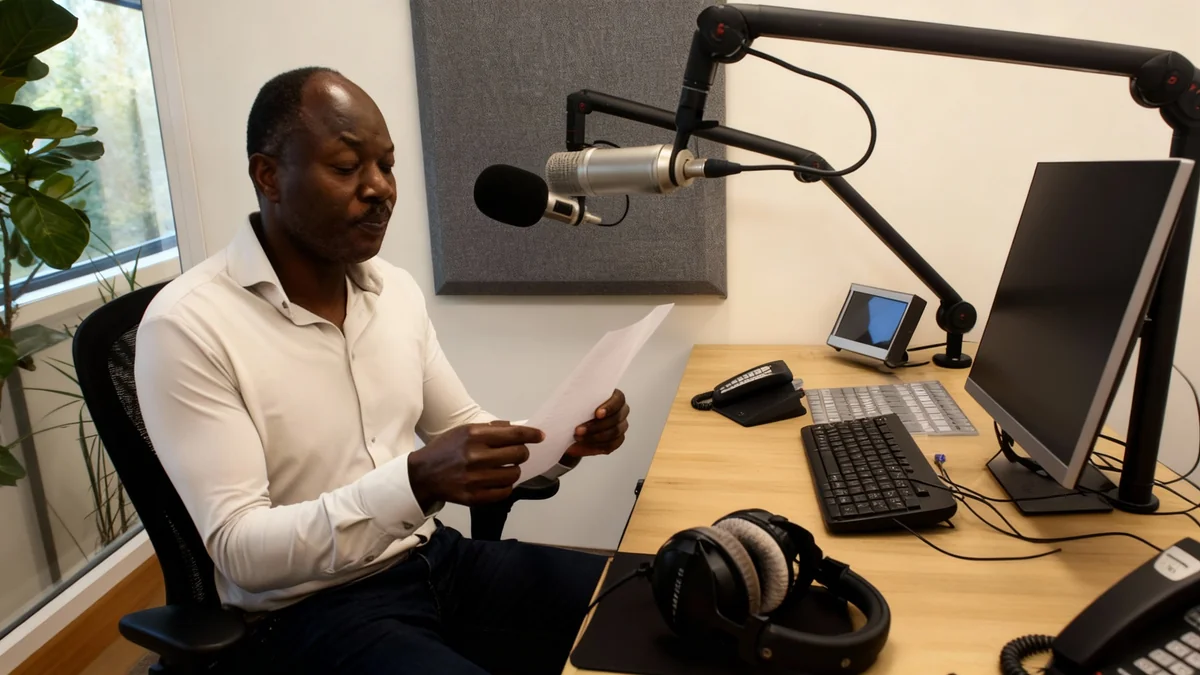


Radio Dabanga, the last independent Sudanese news station, faces an uncertain future after significant budget cuts. Operating from Amsterdam, the station provides vital information to millions of Sudanese people caught in a devastating civil war, where access to reliable news is scarce.
Key Takeaways
- Radio Dabanga, based in Amsterdam, is Sudan's only independent news source.
- The station provides critical information during a civil war that has displaced 14 million people.
- Budget cuts, primarily from U.S. foreign aid, have led to service reductions.
- Journalists and media infrastructure in Sudan have been severely impacted by the conflict.
- Fundraising efforts are underway to prevent the station's closure in April.
A Lifeline in a Country in Darkness
Earlier this year, Radio Dabanga had to cut its morning broadcast due to budget shortfalls. Kamal Elsadig, the station's editor-in-chief, immediately received messages from listeners expressing their concern. Many Sudanese depend on the station for news about their families and the ongoing conflict.
One listener, from a refugee camp in eastern Chad, wrote, "We don't know what is happening to our families and we depend very much on Radio Dabanga." Another in northern Sudan pleaded for the morning service to resume, highlighting its importance.
Sudan Crisis at a Glance
- 150,000 people killed since fighting began in 2023.
- Approximately 14 million Sudanese have been forced from their homes.
- 90% of media infrastructure in Sudan is destroyed.
- Over 400 journalists have fled the country.
Sudan's civil war, which began in 2023 between the Sudanese army and the Rapid Support Forces, has created a severe humanitarian crisis. Statistics are difficult to gather, but reports indicate widespread fighting and hunger.
The Information Vacuum
Amid the conflict, access to information has become critically scarce. Reports from Free Press Unlimited, an Amsterdam-based press freedom organization, indicate that about 90% of Sudan's media infrastructure has been destroyed. More than 400 journalists have fled the country, and over a dozen have been killed or kidnapped.
"Sudan has become completely in a darkness of access to information," Elsadig stated.
From their Amsterdam office, Radio Dabanga journalists work to provide verified information. They report on battle zones, disease outbreaks in refugee camps, and the aftermath of atrocities, such as those in el-Fasher.
The Origins of Radio Dabanga
Kamal Elsadig founded Radio Dabanga in 2008. He came to the Netherlands from el-Fasher, a city in the Darfur region of western Sudan. The station initially focused on Darfur, which was the epicenter of a conflict in 2003-2004 that the U.S. government and human rights groups called genocide. The International Criminal Court recently convicted a Janjaweed leader for war crimes in Darfur, two decades after those events.
Many observers fear that the current Rapid Support Forces, which evolved from the Janjaweed militia, are repeating history with accusations of mass killings, sexual violence, and starvation sieges.
Funding Challenges and Community Support
The future of Radio Dabanga is now in jeopardy. Early this year, a significant portion of U.S. foreign assistance programs were cut. Since U.S. aid made up more than half of the radio's nearly $3 million budget, the station had to reduce staff, freelance contributions, and temporarily halt its morning news service.
In response to the crisis, community efforts are underway to raise funds. Jean-Pierre Fisher, co-founder of Marimba Amsterdam, an organization focused on the city's African diaspora, recently hosted a fundraiser for Radio Dabanga.
The event, held during the Amsterdam Dance Event, brought together activists and a Radio Dabanga reporter to discuss the situation in Sudan and the importance of keeping the station on air.
Voices from the Diaspora
Among the attendees were Sudanese sisters Maaza and Amany Altareeh, who sought asylum in the Netherlands three years ago. Their family remains in Sudan, facing extreme communication challenges.
"It is really difficult to reach them because there is no internet, there are no satellites," said Maaza Altareeh, 33. "The only way to reach people in Sudan is through Starlink satellite internet, which is only possible if someone in the neighborhood happens to have one."
Maaza primarily gets news from social media, but struggles to verify its accuracy. She emphasized why Radio Dabanga is different: "Anytime that we see any type of news, we try to hold [onto] that. This is still happening in Sudan: People are starving and dying and being killed, kidnapped, assaulted, all of these things. And it is important for the radio as the last stand, since there are no televisions now, there are no newspapers..."
The fundraiser offered a glimmer of hope. Maaza Altareeh expressed her gratitude: "Honestly, I was so happy to know that there are people who are not even Sudanese who care about it, it's very special to me." Her 27-year-old sister Amany planned to share pictures of the event with their father in Sudan, to show him that people still care.
The Fight for Information Continues
While a few thousand dollars have been raised, the station still faces a budget shortfall of around $1.5 million. Radio Dabanga's current funding is set to run out in April.
The station believes its online website could continue operating. However, for most Sudanese listeners who rely on radio broadcasts, much more is at stake. Elsadig fears that many Sudanese people may die if they lose access to reliable information during wartime.
Despite the significant challenges, Elsadig remains determined. "We will continue fighting on this, and we will keep hoping," he affirmed. The struggle to keep Radio Dabanga on air is a fight for verified information in a country plunged into darkness.