

After a distinguished career in high-end retail, including a management role at the prestigious Corning Museum of Glass, JoAnne Sharman has embarked on a new chapter as a full-time artist. Since retiring in late 2024, she has applied over three decades of sales expertise to build a successful business around her fluid acrylic paintings, demonstrating that for an independent artist, business acumen can be as crucial as creative talent.
Key Takeaways
- JoAnne Sharman, a former store manager at the Corning Museum of Glass, is now a full-time professional artist.
- She leverages more than 35 years of experience in high-end sales to sell her own artwork.
- Her artistic style, fluid acrylic pouring, is directly inspired by the properties of molten glass.
- Sharman advocates for artists to develop strong sales and business skills to achieve financial stability.
A New Career After Retirement
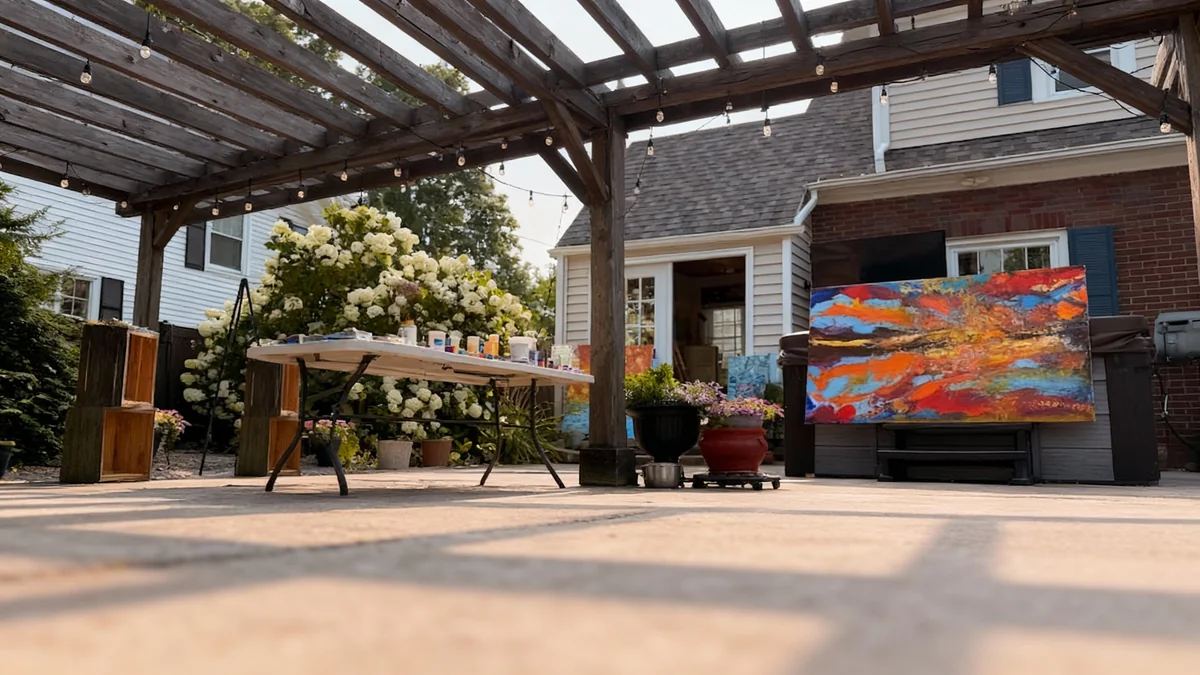
JoAnne Sharman transitioned to a full-time career as a paint-based artist in December 2024 after retiring from her position as a store manager for the Corning Museum of Glass. At age 60, Sharman described herself as not being a “sitter” and now dedicates her days to creating art in her studio in Auburn, New York.
This move marked the culmination of a lifelong passion. Her friend, Terri Wise, noted that Sharman has always been a creative individual. Wise recalled how in the 1990s, Sharman would find and repaint old furniture from flea markets, giving the pieces a new life. According to Wise, retirement provided Sharman with the opportunity to fully flourish as an artist.
“The universe heard her calling, so it gave it back to her so she could be an artist,” Wise said.
The Art of the Sale
Sharman’s approach to selling her work is heavily influenced by her extensive background in sales. With over 35 years of experience in high-end commission sales across jewelry, furniture, and interior design, she understands the psychology of connecting with a buyer.
She emphasizes the importance of “overcoming objections,” a sales skill she once taught to others. “There’s as much sales skill needed as art skills,” Sharman stated. This means not accepting a potential customer's hesitation at face value but engaging them in conversation to build confidence and comfort.
A Real-World Example
At the Keuka Arts Festival, a woman was considering a two-piece painting of coral. When the woman said she needed to think about it, Sharman responded, “Don’t let it be the painting you almost bought. Be happy, spend the money, and you will always love it.” The woman purchased the artwork for her office.
To further reduce buyer hesitation, Sharman implemented a customer-friendly return policy. If a potential buyer is unsure, she offers to let them take the piece home to see how it looks in their space. “If you don’t like it, bring it back to me tomorrow,” she tells them, a strategy that removes the immediate pressure of the purchase decision.
From Molten Glass to Fluid Paint
Sharman's time at the Corning Museum of Glass did more than just hone her business skills; it directly inspired her artistic medium. As a store manager, she gained a deep understanding of glass art by observing demonstrations and taking glassblowing classes.
She describes working with molten glass as being similar to “working with honey,” noting its fluid and dynamic nature. “In any form, it’s fluid,” she explained. “You have to turn it and spin it and manipulate it.”
What is Acrylic Pouring?
Acrylic pouring is a fluid painting technique where acrylic paints are mixed with a pouring medium to make them flow more easily. The artist then pours the paints onto a canvas and tilts it to move the paint around, creating unique abstract designs. Sharman manipulates the colors in layers, allowing the paint's movement to guide the final piece.
This experience with the fluidity of glass led her to explore pouring acrylic paints. “I love the spontaneity of it,” Sharman said. “Let the paint dictate what comes next.” This method allows her to create vibrant, abstract pieces that capture a sense of movement and energy.
Building a Business on the Road
Sharman actively sells her work at art shows, traveling with her boyfriend, Steve Donigan, who assists with logistics. She has learned that adapting her strategy is key to success. For a series of shows in Florida, she planned to use a bubble machine to complement her bubble-themed paintings. However, the initial pieces didn't sell because they were too small for the market.
Instead of getting discouraged, she returned home, created larger pieces, and found significant success at subsequent shows on the West Coast. “And man, we got back, and we hit the West Coast and just did very well,” she said.
Donigan observed that Sharman’s most effective sales tool is painting on-site. This live demonstration attracts people and sparks conversation. “People asked questions while she painted, and she involved them in a whole conversation,” he said. This interaction often leads to discussions about where the painting will be placed, allowing Sharman to use her interior design expertise to build a stronger connection. “I think she builds relationships with people that way,” Donigan added. “The shows are what sells them.”
Advocating for Artist Education
Through her experiences, Sharman has observed a significant gap between the number of people who attend art shows and the number who actually purchase art. She believes many talented artists struggle financially because they lack fundamental business and sales skills.
She hopes her journey can inspire other artists to learn the commercial side of their craft. While she can persuade someone to buy a piece, Sharman acknowledges she cannot convince them to love it. The sale itself is a form of validation for her work.
“When you know your work has a home that someone has bought and will enjoy themselves,” she said, “It’s just a cool feeling.”
More information about JoAnne Sharman's work and her studio, Lady Loo Art, can be found on her official website.